Locks or keyless entry fail
The first clue may be slow unlocking, no response from the key or an app that cannot wake the car.
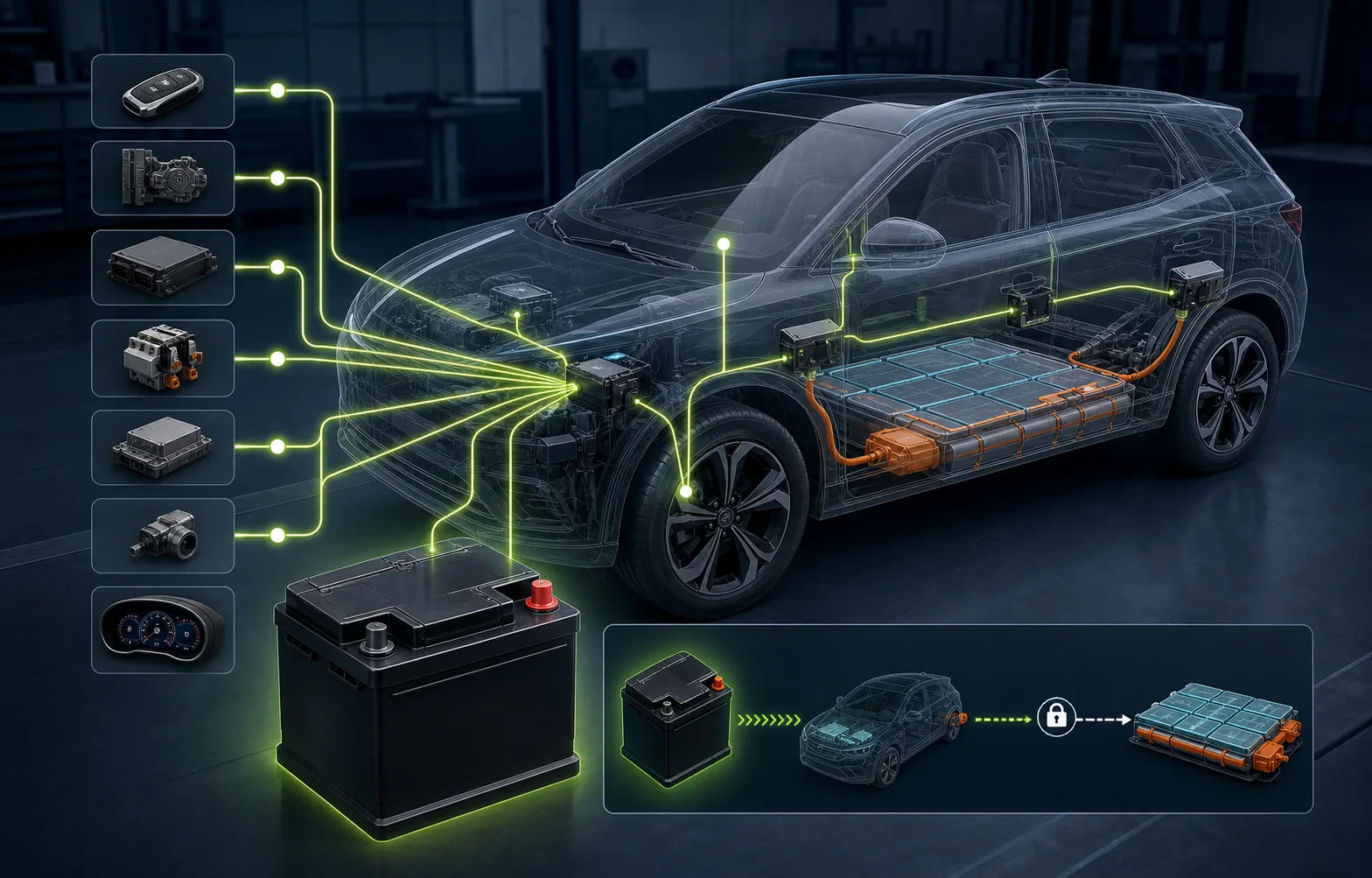
The small battery wakes the computers, operates locks and safety systems, and allows the high-voltage contactors to close. When it becomes weak or repeatedly discharged, the vehicle can appear to have a major EV fault even with plenty of driving range.
An EV normally keeps its high-voltage battery disconnected from the rest of the vehicle while parked. The 12V battery powers the computers that check safety conditions and command the high-voltage contactors when the car is ready or charging.
It also supports central locking, alarms, telematics, screens, brake controls, power steering, lighting and many pumps and relays. Unstable voltage can make several modules reset or communicate badly at the same time.
The DC-DC converter takes over low-voltage support when the vehicle is in the correct active state, but the 12V battery still has to wake the system first and stabilise it between operating states.
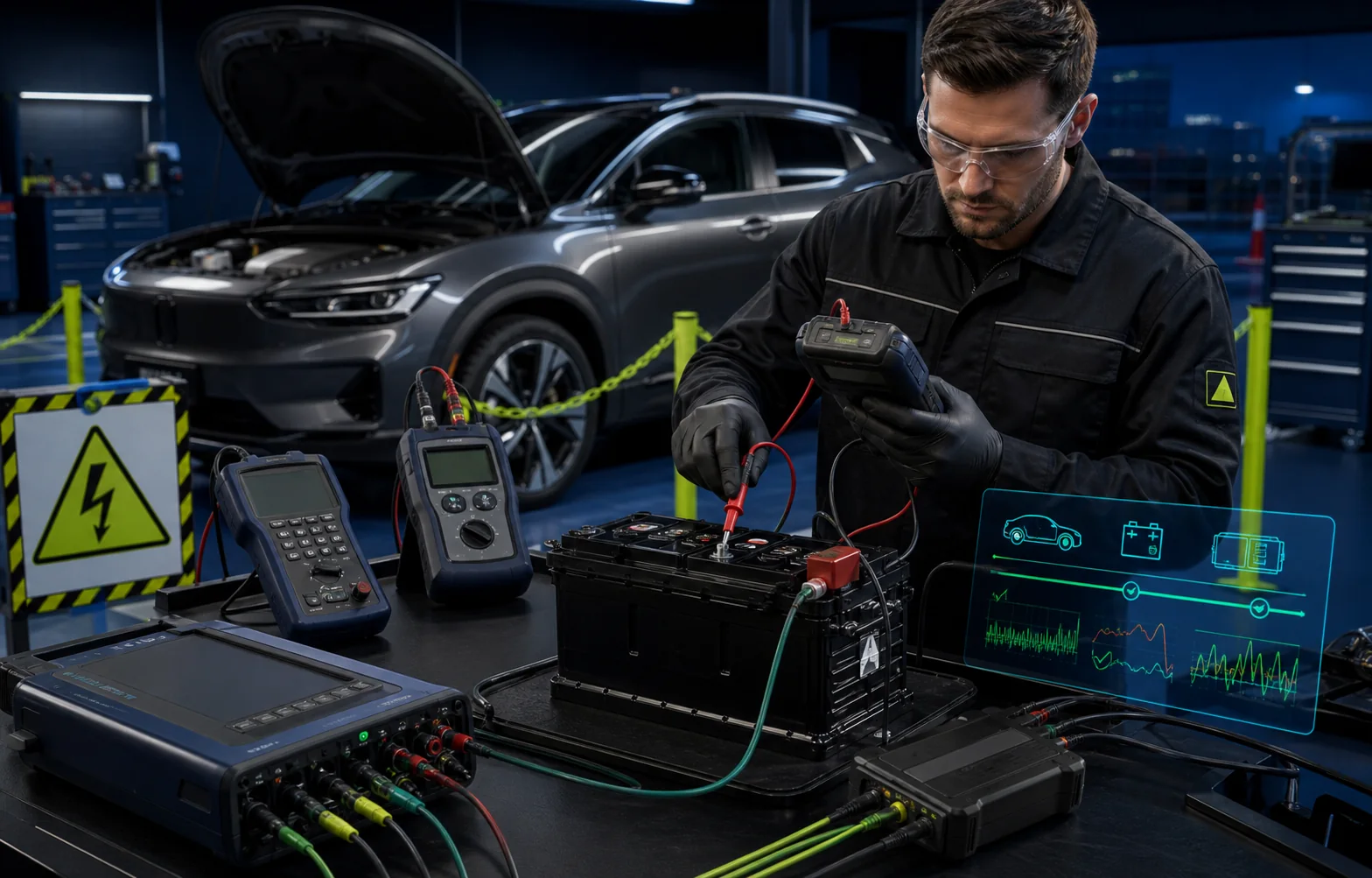
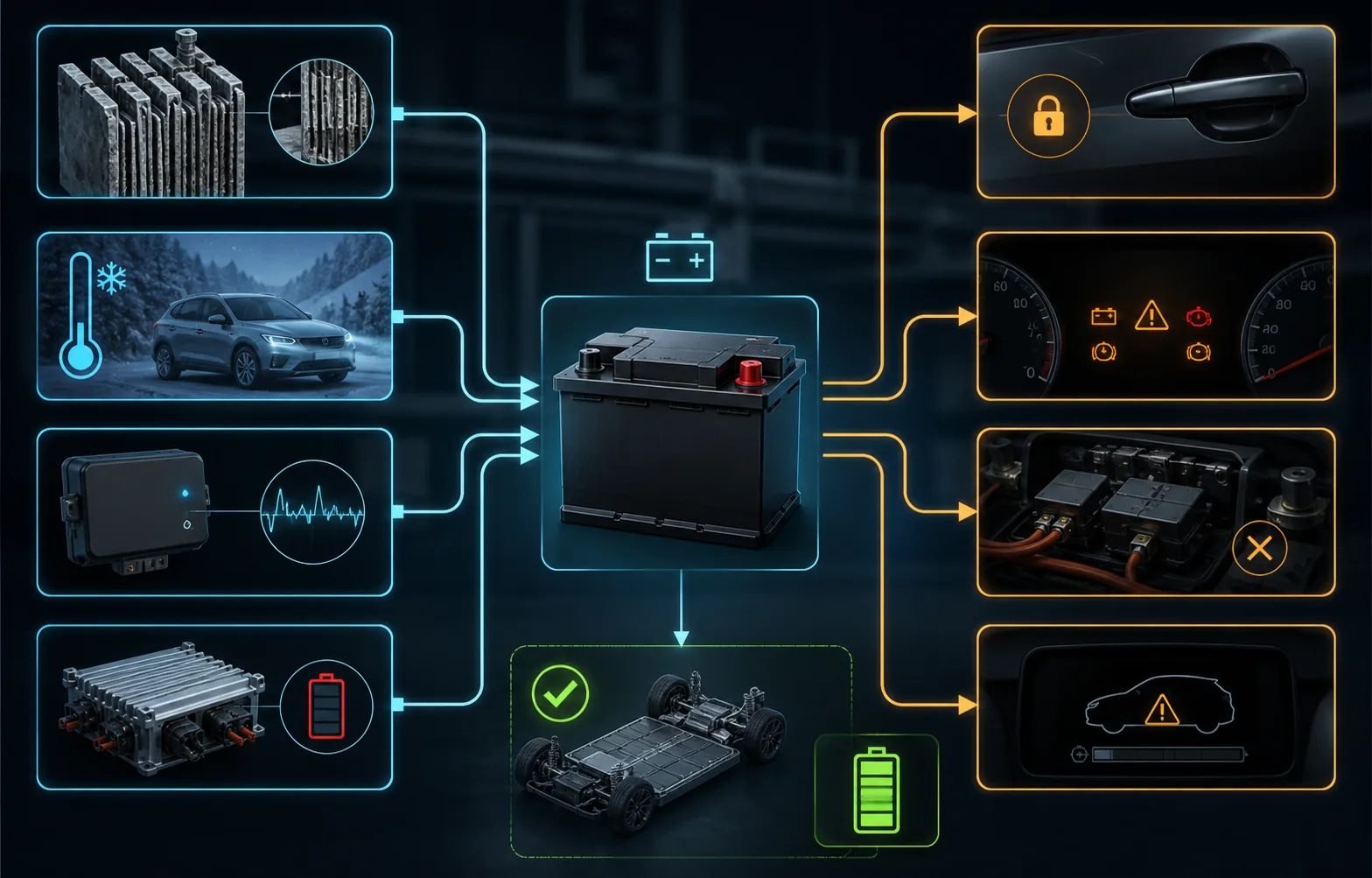
These visuals separate the battery role, the correct diagnostic tests and the causes that can keep flattening a replacement.
 01
01
 02
02
 03
03
The same symptom can come from the battery itself, the DC-DC system, a connection problem or something draining the vehicle while parked.
The first clue may be slow unlocking, no response from the key or an app that cannot wake the car.
Modules booting at different voltages can store brake, steering, airbag, EV and communication faults together.
The computers may wake, but voltage can collapse when relays and contactors are commanded.
Battery age, cold weather, telematics, keys kept nearby, aftermarket equipment or a module not sleeping may be involved.
The charge-port lock and communication modules need reliable 12V power before an HV charging session starts.
If charging support, battery registration, wiring or parasitic drain is not addressed, replacement alone may not last.
A resting-voltage reading is useful, but it is only one snapshot. The diagnosis must cover condition, charging, connections and sleep current.
Ask how long the car was parked, battery age, recent jump starts, temperature, charging behaviour and any accessories. Capture faults and low-voltage history before disconnecting the battery.
Confirm the specified battery type and rating, terminal security, ground points, sensor connection, corrosion, damage and whether previous replacement or registration was completed correctly.
Check the settled voltage, then watch minimum voltage while unlocking, booting modules and commanding ready mode. A battery can show acceptable open-circuit voltage yet collapse under load.
Use an appropriate conductance, internal-resistance or controlled load test for the installed battery technology. Compare the result with temperature, age and manufacturer guidance.
Confirm the vehicle commands low-voltage charging in the expected states, measure converter output and test losses across positive and ground paths under load.
Allow the vehicle to complete its full sleep cycle without repeatedly waking it. Log current long enough to catch telematics or intermittent module wake-ups, then isolate the responsible circuit methodically.
Install the specified technology and capacity, perform battery registration or reset when required, clear only resolved faults and confirm several sleep and wake cycles.
| Test result | What it tells us |
|---|---|
| Voltage looks normal | Open-circuit voltage alone does not prove reserve capacity or behaviour under load. Continue with a battery capability test. |
| Voltage collapses on wake-up | The battery may have high internal resistance, low charge, poor terminals or a high-resistance ground path. |
| DC-DC output is absent | Check whether the vehicle is in the correct operating state, then investigate converter commands, HV availability, wiring and faults. |
| Healthy after charging, flat later | Measure sleep current and wake-up events. A module, tracker, dashcam, key proximity or network activity may be draining it. |
| Repeated battery replacement | Review battery specification, registration, software, charge strategy, connections and parasitic drain instead of fitting another battery blindly. |
For safety, the traction battery is normally disconnected while parked. The 12V battery powers the control units that wake the vehicle, complete safety checks and close the high-voltage contactors.
Yes. Low or unstable voltage can disrupt modules and communication, which may create EV-system warnings even when the traction battery is not the root cause.
No. A multimeter shows voltage at that moment. Battery capability, voltage under load, charging support and parasitic drain require additional tests.
Some vehicles require battery registration, adaptation or a reset so their charge strategy matches the new battery. The exact requirement depends on the manufacturer and model.
Tell us the battery age, how quickly it goes flat, whether the car charges and any warnings. We can test the battery, DC-DC support and parked-current behaviour together.