Hardware compatibility
A superseded or visually identical module may not support the vehicle software or option set.
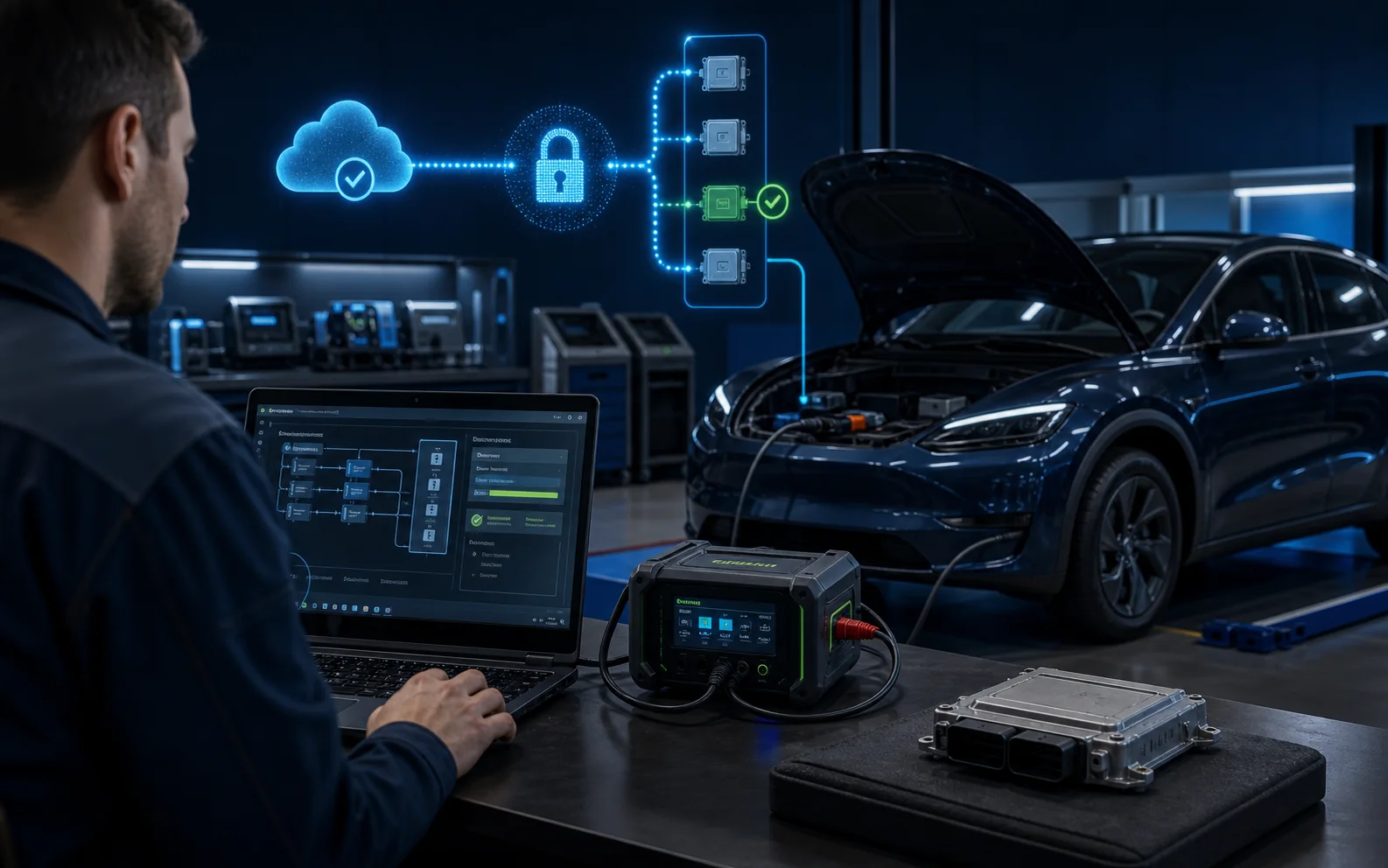
Modern EV control units are software-defined, security-protected and configured to the exact vehicle. Fitting hardware can be only the first half of the repair; authorised access, programming, coding, calibration and verification may all be required.
Two control units can look identical yet contain different hardware revisions, firmware, calibration data or feature coding. The vehicle needs the replacement to match its VIN, equipment and current software integration level.
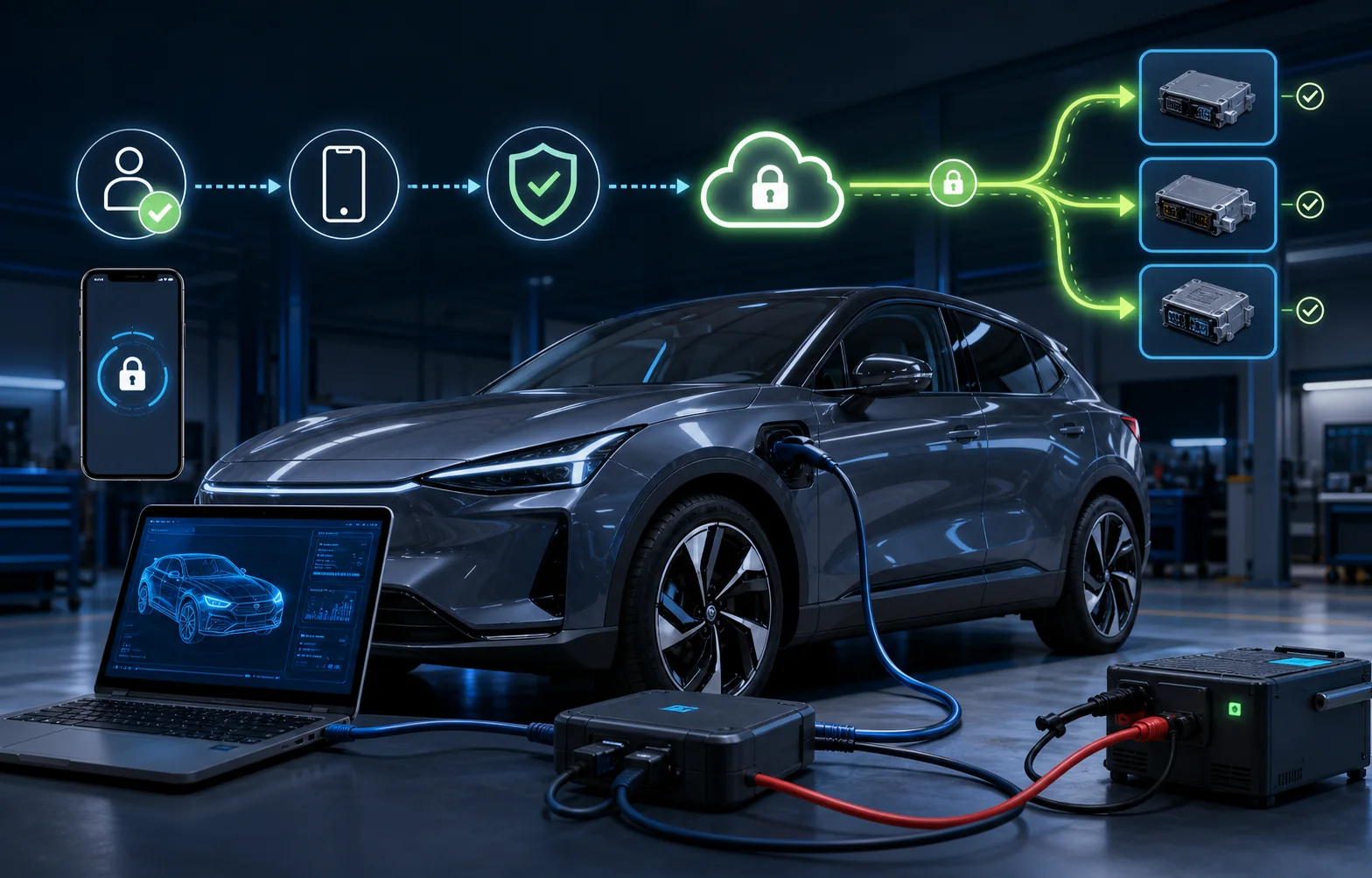
Manufacturers also protect safety, theft-related and cybersecurity-sensitive functions. Legitimate repair access may require a paid OEM platform, technician identity, two-factor authentication and a time-limited secure-gateway unlock.
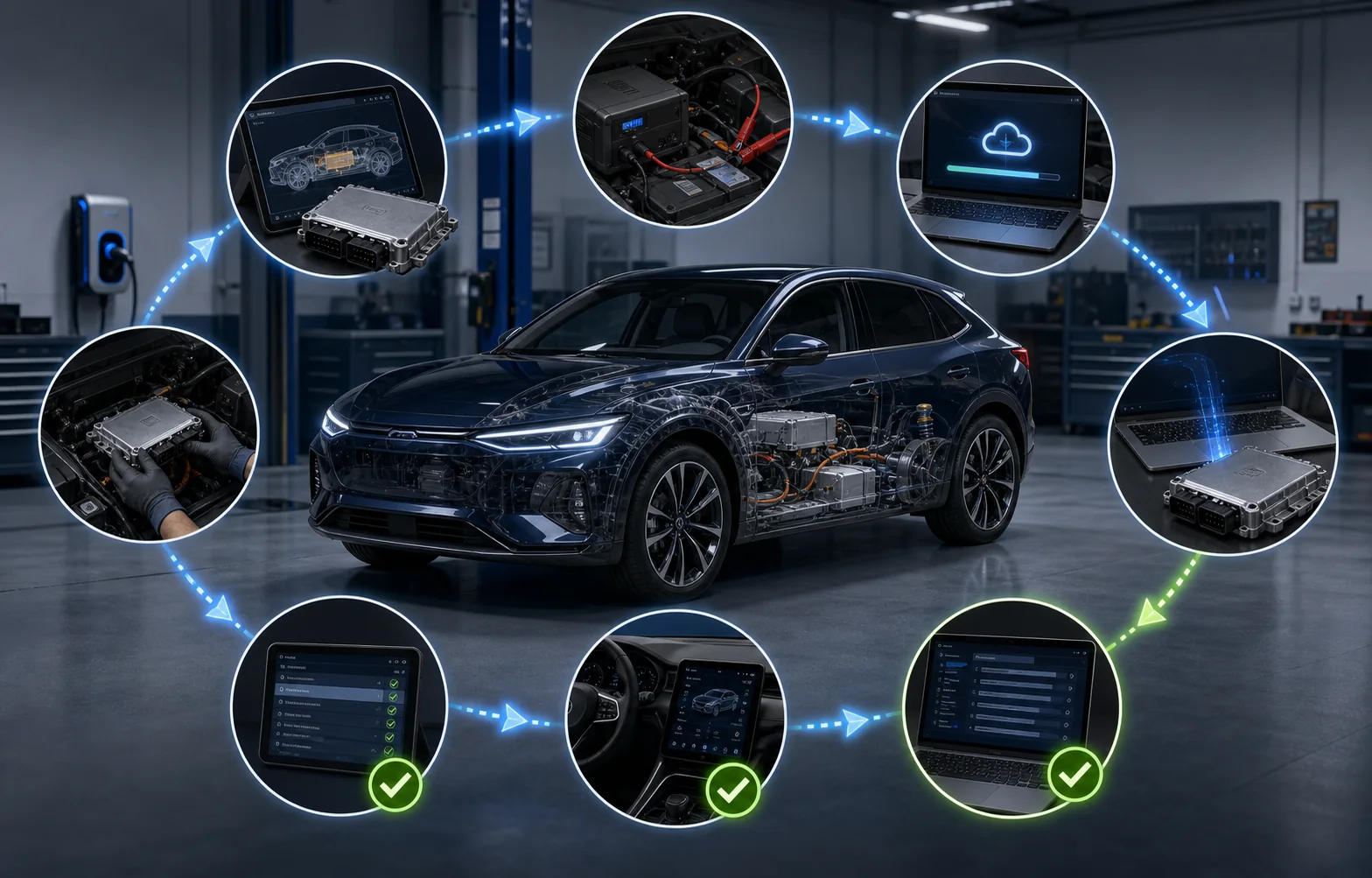
Programming is not simply copying a file. The process can update related modules, initialise a component, teach end stops, calibrate sensors, pair security certificates and run a final vehicle test.
The connection, voltage support, secure authorisation and post-programming checks are just as important as the software download.
 01
01
 02
02
 03
03
The challenge is matching hardware, software, vehicle configuration and security without interrupting a safety-critical process.
A superseded or visually identical module may not support the vehicle software or option set.
The replacement may require a vehicle-wide software level rather than an isolated module flash.
Cybersecurity systems restrict coding, adaptations and other sensitive commands to authorised users.
Immobiliser, component-protection or certificate functions may need a separate controlled OEM process.
The module may need vehicle-order coding, sensor calibration, end-stop learning or commissioning.
Low voltage, network loss, laptop sleep or internet failure can leave a module incomplete or unresponsive.
The best programming repair begins with research, a complete scan and a recovery plan—not after a replacement has already been fitted.
Confirm VIN, production date, options, current software level, fault evidence, exact part number and whether the manufacturer permits a new, remanufactured or used component.
Complete a full scan, record module identities, software versions, coding, calibrations and learned values where the OEM process allows.
Connect a correctly rated voltage support unit, use the approved interface, secure a reliable wired or workshop network and confirm OEM subscriptions and authentication before starting.
Allow the OEM tool to identify required software, dependencies and affected control units. Do not interrupt the session or guess at individual files.
Apply vehicle-specific configuration, complete component start-up, teach-in routines, security pairing and any steering, brake, camera, radar or thermal calibration requested.
Run a complete post-scan, clear only resolved faults, check functions, charging and ready state, then road-test where appropriate and document the final software status.
| Manufacturer example | Why the job needs planning |
|---|---|
| Volkswagen Group / SFD | Protected diagnostic functions on supported vehicles require authenticated, time-limited authorisation. Coding may also involve component protection or immobiliser procedures depending on the module. |
| BMW / MINI with ISTA | ISTA identifies the vehicle software state and calculates a measures plan. A replacement can require programming and coding of related control units, followed by initialisation and a final vehicle test. |
| Mercedes-Benz / XENTRY | Some control units require online coding, commissioning or security access through the manufacturer environment after replacement. |
| Stellantis secure gateway | Protected commands may require authenticated gateway access before bidirectional tests, configuration or programming can proceed. |
| ADAS or chassis modules | Successful software installation is not the finish if steering angle, ride height, camera, radar or brake functions still require calibration. |
The unit may contain another vehicle identity, incompatible software, security data or coding. Some manufacturers restrict whether certain used modules can be commissioned at all.
SFD is a Volkswagen Group protection system for selected diagnostic functions. An authorised user requests time-limited online permission before carrying out protected work; it is not a fault or a bypass.
BMW software is managed as a vehicle integration level. ISTA can calculate a measures plan that aligns dependent control units rather than treating every ECU as an isolated device.
Control units and vehicle networks remain awake throughout programming. Stable voltage reduces the risk of resets or communication loss while software is being erased and written.
Send us the VIN, current part number, replacement part details and scan report. We can identify the likely OEM access, coding and calibration requirements first.