Forced-air cooling
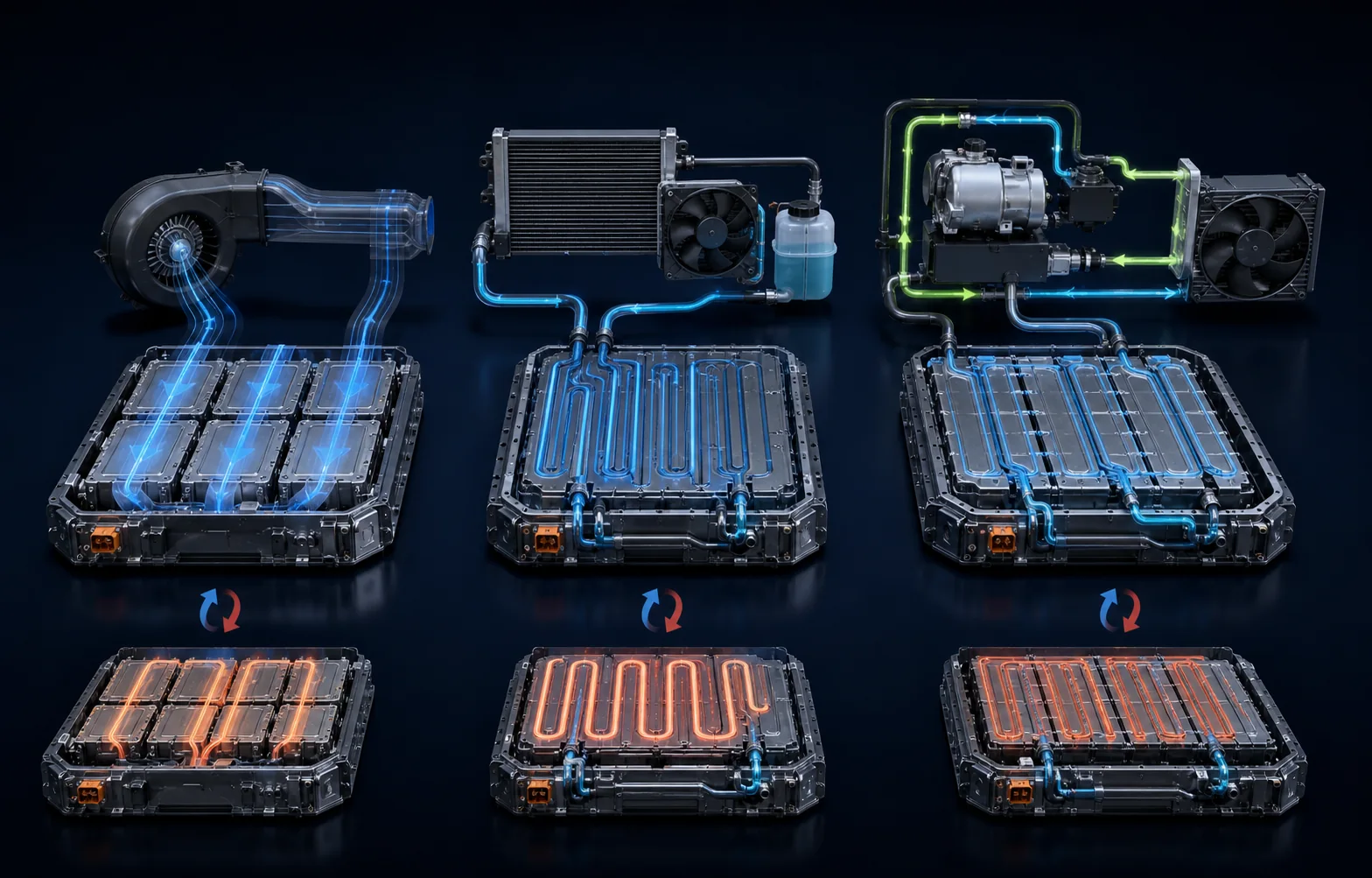
Fans move air through ducts around the pack. Blocked inlets, dust, trim or fan faults reduce performance.
EV batteries generate heat while driving and charging, but they can also be too cold to perform at their best. Thermal management uses air, liquid coolant and sometimes the air-conditioning refrigerant circuit to keep cell temperatures controlled and even.
Cells produce heat through internal resistance, especially during high power driving and rapid charging. Excess heat accelerates ageing, while very low temperature can reduce available power and charging acceptance. Large temperature differences across one pack can also make some cells reach their limits before others.
Air-cooled packs use fans and ducts. Indirect liquid-cooled packs circulate a water-glycol mixture through plates or channels. More advanced systems connect that coolant loop to an air-conditioning chiller for additional cooling, and may use a heater or heat pump to warm the pack.
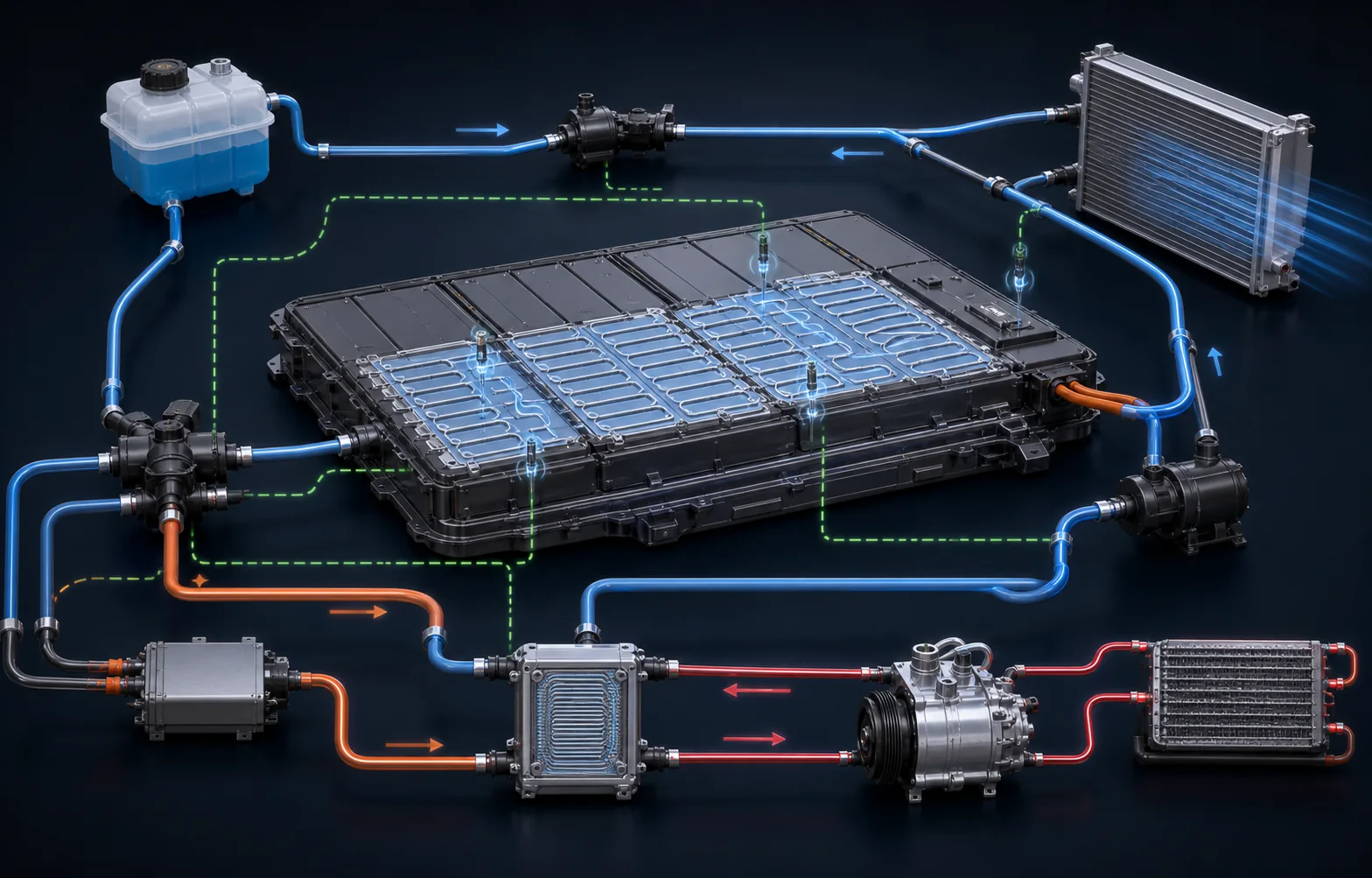
There is no single universal layout. The battery circuit may share or exchange heat with the motor and cabin systems, or remain separately valved. Correct filling, bleeding, refrigerant charge and software-controlled valve operation are therefore vehicle-specific.
Some vehicles combine these methods. Refrigerant usually cools the battery coolant through a heat exchanger rather than circulating through the cell modules themselves.
 01
01
 02
02
 03
03
The correct service method depends entirely on how the manufacturer designed that vehicle.
Fans move air through ducts around the pack. Blocked inlets, dust, trim or fan faults reduce performance.
Coolant flows through plates or channels, transferring heat without touching the cells.
Refrigerant absorbs heat from the coolant through a heat exchanger during demanding conditions.
A coolant heater, motor heat or heat pump can warm a cold pack before use or charging.
Valves may link battery, drive unit and cabin circuits in different combinations.
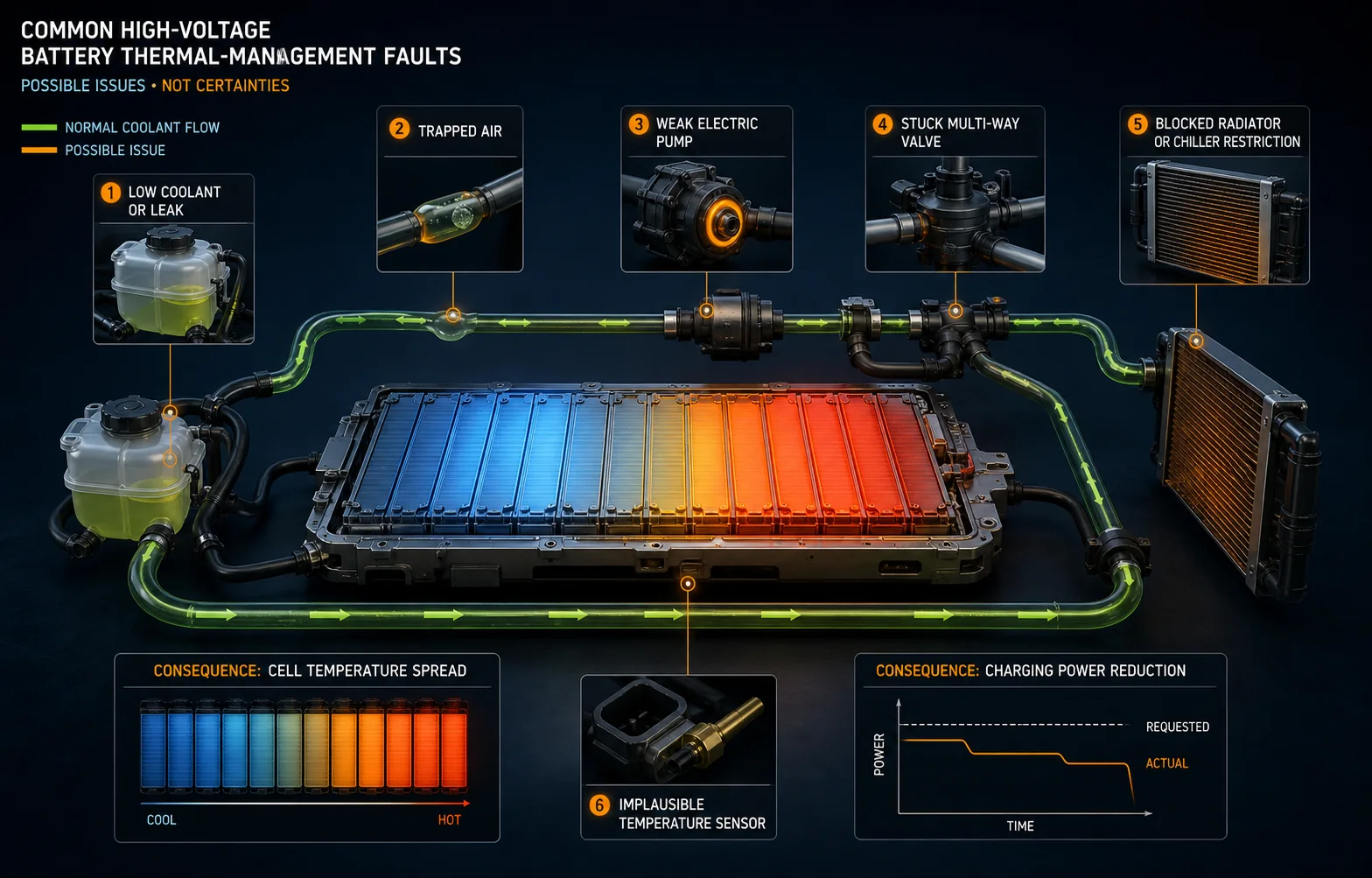
The BMS may reduce rapid charging, acceleration or regenerative braking when temperature is unsuitable.
A warning or reduced rapid-charge speed does not prove the battery itself has failed.
Record ambient temperature, battery temperature, journey history, charge power, state of charge and whether the fault occurs while driving, parked or rapid charging.
Read BMS, thermal, air-conditioning, motor and charging modules. Preserve temperature values, pump speeds, valve positions, pressure readings and any power limitation reason.
Check the correct coolant level and specification, evidence of leaks, hose damage, blocked air ducts, radiator condition and previous cooling-system work.
Use approved bidirectional tests and observe electrical response, sound, flow and temperature change. A commanded percentage does not prove the device physically moved.
Look for implausible sensors, a persistent hot zone or poor thermal uniformity. Infrared checks are used only where access and OEM guidance make them meaningful.
Where fitted, verify A/C pressure, refrigerant charge, compressor operation and heat transfer across the chiller with suitable equipment and qualification.
| Symptom | Possible thermal causes |
|---|---|
| Rapid charge slows early | High or low battery temperature, poor flow, chiller performance, cell limits or the charger itself may be responsible. |
| One area stays hotter | A flow restriction, air pocket, poor cold-plate contact, sensor error or local cell condition needs investigation. |
| Pump runs constantly | The system may be responding to heat, an incorrect sensor, a valve fault, reduced flow or a software strategy—not necessarily a bad pump. |
| Cabin A/C works, battery hot | The battery chiller, valve route, coolant flow or requested refrigerant control can still be faulty even when cabin cooling feels normal. |
| Fault after coolant work | Incorrect coolant, trapped air, incomplete vacuum filling, wrong valve position or an unperformed bleed routine are important clues. |
Usually the refrigerant cools a separate liquid coolant circuit through a chiller. Some designs differ, so service information must identify the exact architecture.
Cold cells have greater internal resistance and may accept less charging or deliver less power. Controlled warming can improve operation and rapid-charge performance.
Yes, if low level or trapped air reduces battery heat removal. However charge power also depends on cell temperature, state of charge, charger capability, battery condition and software limits.
Only use the exact manufacturer-specified fluid and filling method. Electrical conductivity, corrosion protection and material compatibility can be critical in an EV thermal circuit.
Tell us the vehicle, warning, temperature conditions and charging behaviour. We can assess the battery, coolant, valve and refrigerant evidence together.