Weak 12V supply
Low voltage can restart modules, interrupt CAN messages, prevent contactor closing and create unrelated-looking warnings.
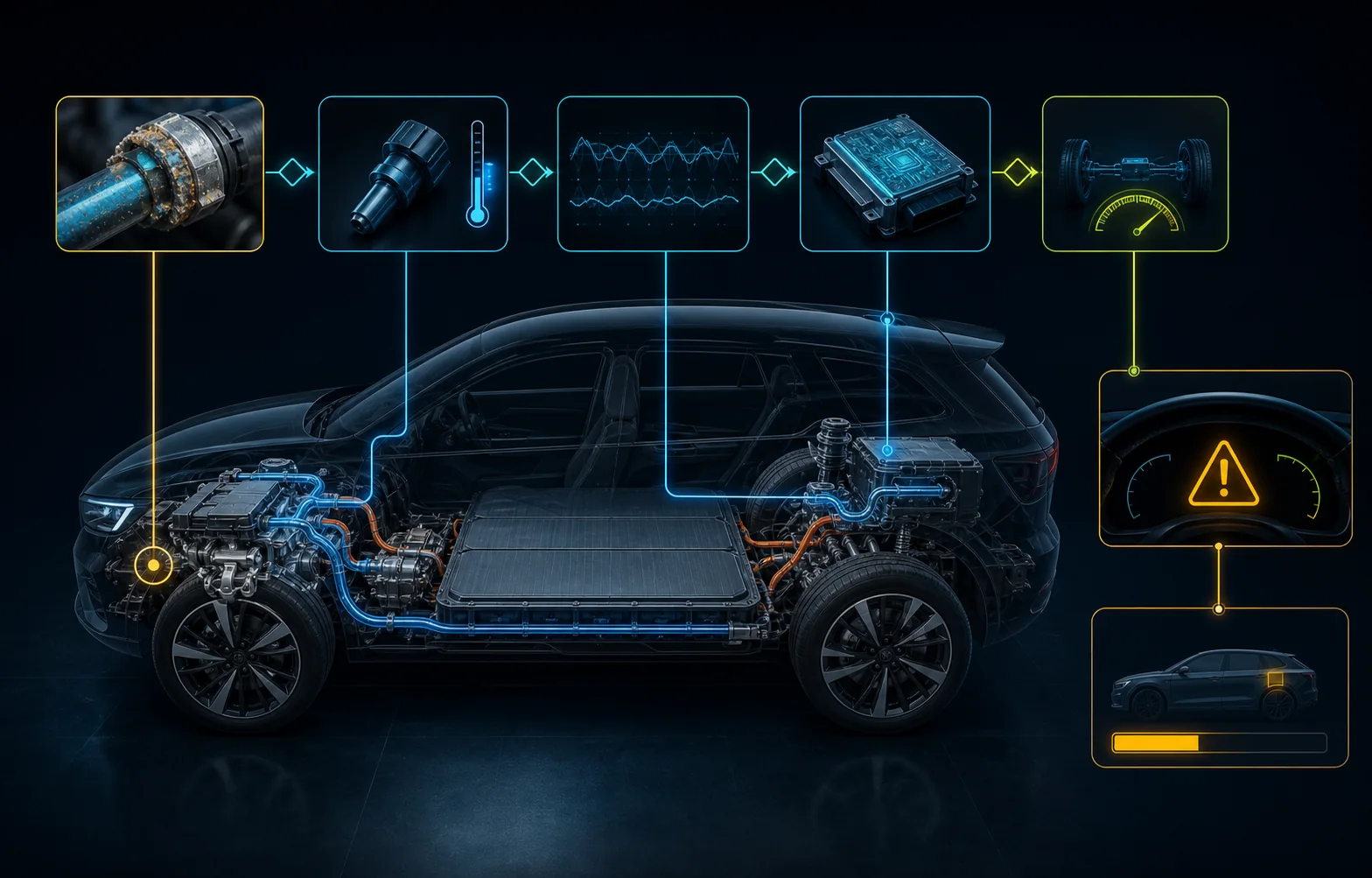
Modern EVs contain dozens of control units that share power, data and safety decisions. One weak supply, failed sensor or lost message can create a chain of secondary warnings. Good diagnosis works backwards from consequences to the first proven cause.
A primary or root-cause fault is the condition that starts the problem. Consequence faults are the reactions recorded by other modules when a signal, voltage, temperature, torque request or network message becomes implausible or disappears.
For example, a weak 12V battery can create undervoltage codes, lost communication, brake warnings and a no-ready condition. Replacing every module named in those codes would miss the common supply problem.
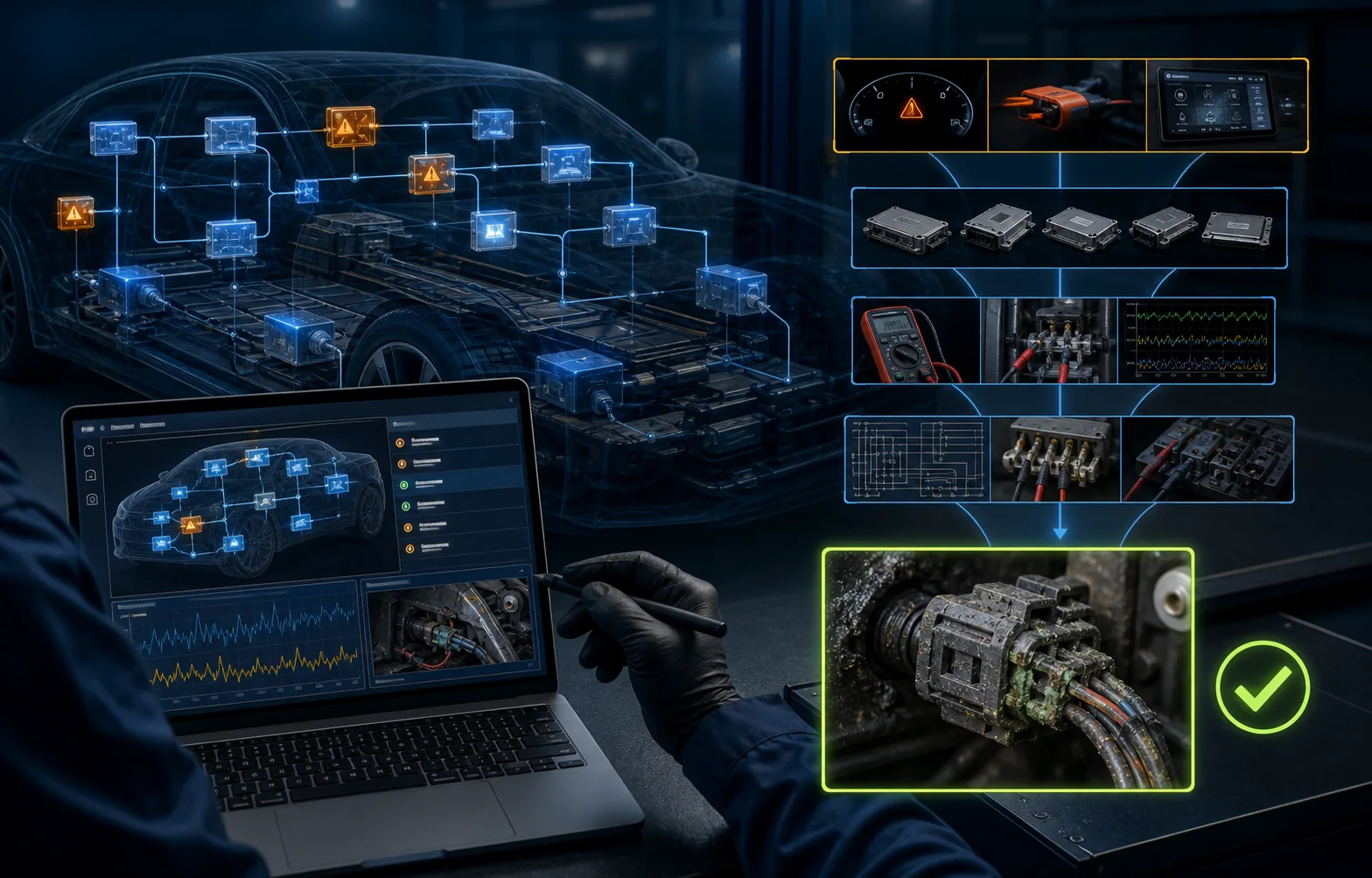
The diagnostic job is to group related faults, compare timestamps and operating conditions, test shared inputs and then verify that repairing one cause removes the whole chain.
A professional diagnosis turns a confusing fault-code list into a timeline, a shared-system map and a testable root-cause theory.
 01
01
 02
02
 03
03
These examples show why the relationship between systems matters more than the number of codes stored.
Low voltage can restart modules, interrupt CAN messages, prevent contactor closing and create unrelated-looking warnings.
A pump, airlock or coolant issue can raise inverter temperature, trigger torque reduction and end with a drivetrain warning.
Corrosion or a poor terminal can distort one sensor signal, causing the control unit to disable a wider system for safety.
One missing module or damaged communication pair can produce lost-message codes in many healthy modules.
The BMS may request reduced power because of temperature, voltage spread or state limits; the inverter then records the consequence.
A wheel-speed fault can affect ABS, stability, regenerative braking and driver-assistance systems at once.
The aim is not to make every code disappear individually. It is to explain why they appeared together.
Record the exact warning, what the driver was doing, state of charge, temperature, charging status, recent repairs and whether the fault is current or intermittent.
Before trusting module behaviour, test and support the low-voltage system. Programming, scanning and actuator tests all depend on stable voltage.
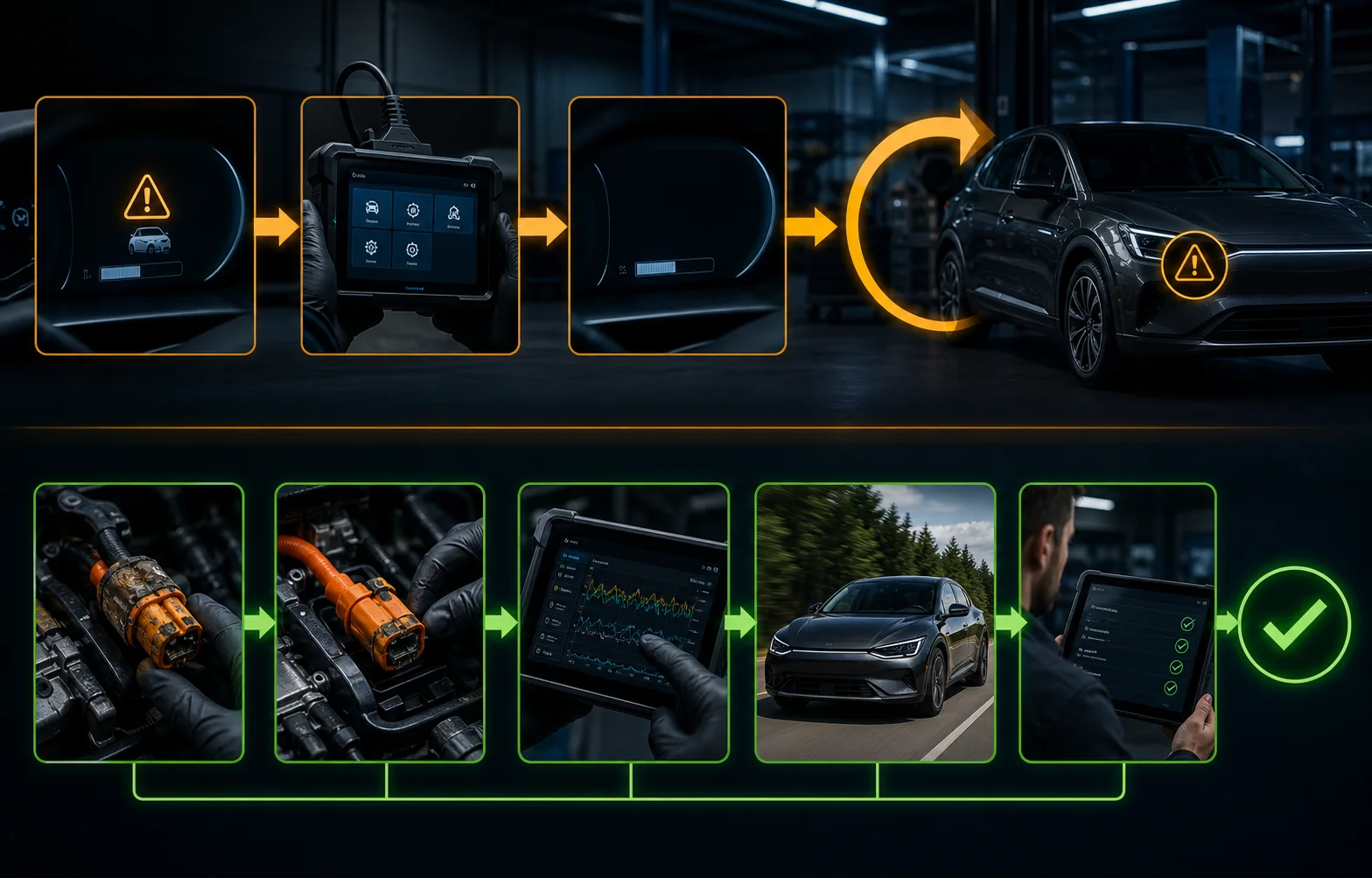
Preserve active, stored and history codes with freeze frames. Do not clear the vehicle before comparing which modules recorded which event and when.
Look for a common power feed, ground, network, sensor, temperature condition or torque message. Separate primary electrical evidence from protective reactions.
Use voltage-drop tests, wiring load checks, oscilloscope or network measurements, live data comparison, physical inspection and approved component tests.
Clear faults only after evidence is saved, then repeat the charge, road, temperature or wake-up conditions. Complete a post-repair scan and confirm the chain stays resolved.
| Fault pattern | Diagnostic meaning |
|---|---|
| Many undervoltage codes | Test the 12V battery, DC-DC output, grounds and voltage history before treating individual modules as failed. |
| Several lost-message codes | Find which module is missing and whether its power, ground or shared communication path failed first. |
| Inverter torque limited | The inverter may be obeying a limit requested by the BMS, thermal system, traction control or another safety controller. |
| Charging and isolation faults | A charging refusal may be the protective consequence of moisture, interlock or insulation evidence elsewhere. |
| Warning returns after clearing | The initiating condition remains. Repeated deletion changes no wiring, voltage, temperature or mechanical cause. |
Several systems can depend on the same voltage supply, network message or sensor. One initiating fault can make each dependent module store its own protective or communication warning.
Not necessarily. The inverter may have detected a problem, received a limit request or lost a message. Power, cooling, motor, battery and network evidence must be checked first.
Only after the original evidence has been saved. Clearing can help test whether a fault returns, but erasing codes before recording freeze frames can destroy the best clue to the event sequence.
The initiating condition tests correctly, the vehicle completes the original operating scenario, no related faults return and a full post-repair scan supports the result.
Send us the complete scan and describe which warning appeared first. We will help map the fault chain and choose the tests that can prove its origin.